
How Plus+ compressed a complex ecosystem into a business model that can actually run
Some business ideas are not weak because they lack vision.
They are weak because they have too much of it.
That was the challenge with Plus+.
On paper, the system had real strategic power. It connected membership commerce, loyalty mechanics, service locations, product exposure, customer rewards, and logistics into one ambitious ecosystem. The thinking behind it was intelligent. The incentives made sense. The long-term potential was clear.
But there was a problem.
The system was too difficult to understand, too dependent on explanation, and too complex to execute consistently in the real world.
Plus+ did not need more features. It needed compression.
The Starting Point: A Powerful System That Was Too Hard to Adopt
Plus+ began as a founder-driven ecosystem with multiple moving parts.
It could be understood as a discount program. Or an ecommerce platform. Or a logistics model. Or a loyalty system. Or a rewards engine.
That was exactly the problem.
When a business can be interpreted in too many ways, customers hesitate. Operators improvise. Partners ask for more explanation. And the founder becomes the only person capable of making the system make sense.
The original mindset was:
“The system is powerful, so it should work.”
But the real operating truth was different:
“The system must be understood before it can work.”
The founder had strong strategic vision, deep understanding of arbitrage and incentives, and a high tolerance for complexity. But customers and operators do not adopt systems because they are complete. They adopt them because they are simple, useful, and repeatable.
That became the first major insight.
More complete does not always mean more valuable. Sometimes, more simple means more adoptable.
The Real Constraint Was Not the Idea. It Was Translation.
Plus+ already had the ingredients of a strong business model.
But the system was suffering from what we identified as a System Translation Gap.
The business existed conceptually, but it could not yet execute consistently in the real world.
There were four major constraints.
First, there was a concept clarity failure. The market did not have a clean category for Plus+. Was it a membership? A rewards system? A product commerce layer? A loyalty loop?
Second, there was a demand validation gap. The business needed behavioral proof, not just strategic logic. It needed evidence that customers would join, buy, return, and repeat.
Third, there was a replicability risk. If the system required the founder to explain it every time, then it was not yet scalable.
Fourth, there was too much operational complexity. Too many products, too many entry points, and too many layers were exposed to the customer too early.
The issue was not whether the ecosystem could become valuable. The issue was whether one part of it could work every time.
The Strategic Shift:
Stop Scaling the Ecosystem. Prove One Node.
The original instinct was to build the ecosystem first.
That meant creating the larger platform, connecting all the pieces, and assuming that the full value would become obvious once the system was complete.
But that path created friction.
So the strategy changed.
The new direction was:
Do not scale the ecosystem yet. Stabilize one node until it becomes automatic.
A Plus+ node was defined as:
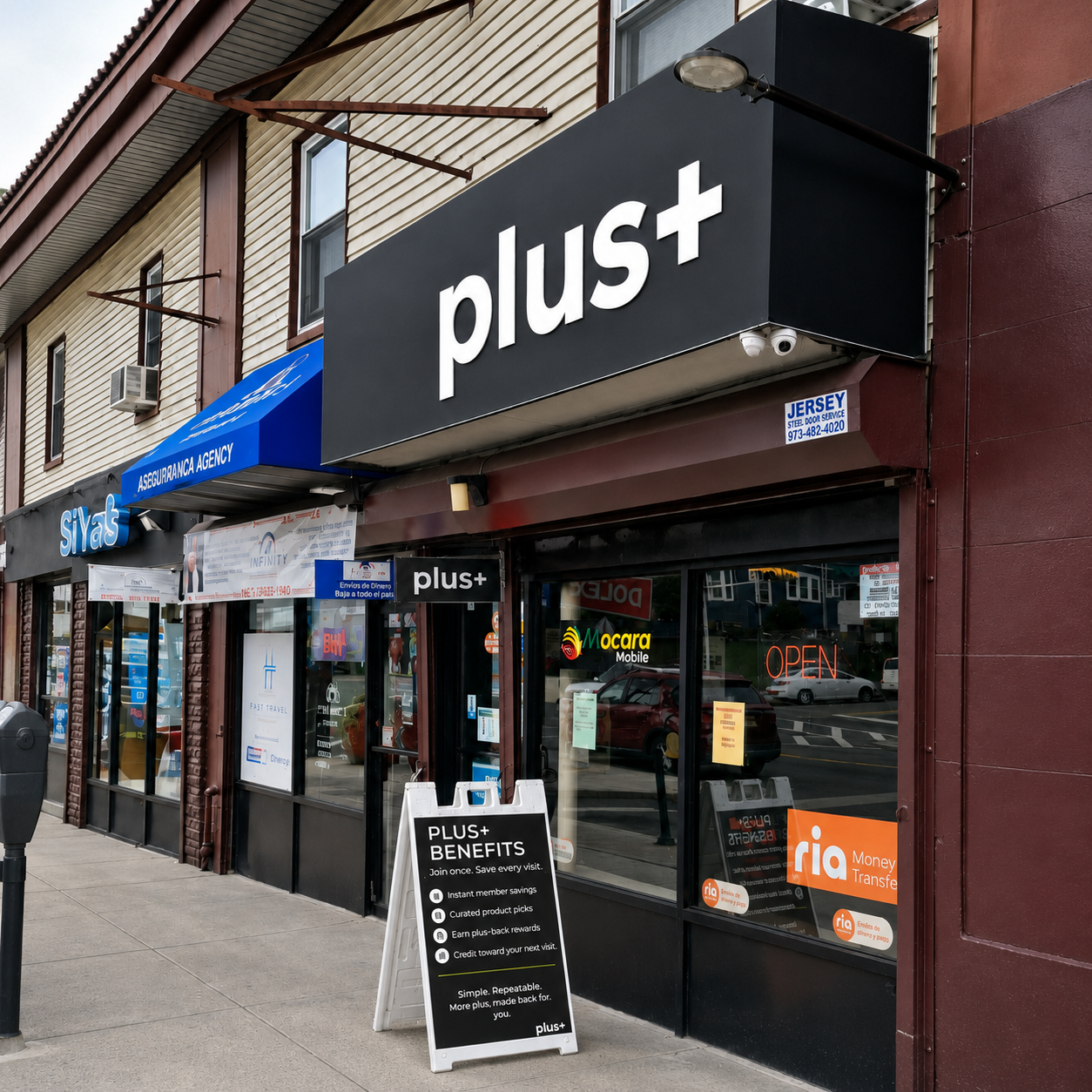
A service location that converts visits into recurring commerce through membership, product exposure, and plus-back return loops.
This changed everything.
Instead of asking the market to understand the entire ecosystem, Plus+ only needed to prove one repeatable unit.
One location.
One customer path.
One membership offer.
A small number of curated products.
One return mechanism.
One measurable economic loop.
The growth logic became:
Compression → Standardization → Validation → Replication
This was the turning point.
Plus+ stopped behaving like a marketplace and started becoming what it really was:
a behavior system.
And behavior systems must be simple, repeatable, and observable.
The New System:
A Closed Loop That Creates Return Behavior
Once Plus+ was compressed into a single-node model, the customer journey became much easier to design.
The customer enters through a service visit.
At that moment, the membership is introduced immediately and simply. The customer does not need a full explanation of the entire system. They only need to understand the immediate benefit.
Then, during the service experience, product exposure happens naturally. Not through browsing. Not through aggressive selling. Not through a complicated catalog.
Only through what was actually used.
The operator recommends one relevant product at one clear moment.
At checkout, the customer receives plus-back value, creating a reason to return.
The loop becomes:
Service visit → membership → curated product exposure → plus-back → return visit
That is the economic engine.
Membership anchors commitment. Product margin creates upside. Plus-back creates the return trigger.
The customer experiences savings, discovery, and future value.
The operator follows a simple behavior.
The founder no longer has to explain the system manually.
That is when the model starts becoming real.
The Operator Shift:
From Selling to Recommending
One of the most important changes was removing the burden of selling from the operator.
The operator system became simple:
Recommend only what was used.
Recommend at one clear moment.
Keep product options limited.
Make commission visible.
Do not explain the full system.
This matters because most businesses overestimate how much complexity front-line operators can carry.
A system that requires constant explanation, persuasion, or interpretation will drift quickly.
Plus+ became stronger when the operator did not need to think through the whole ecosystem.
They only needed to execute one behavior consistently.
That is the difference between a clever idea and an operating model.
The Results:
Less Explanation, More Execution
The redesigned Plus+ model created a clearer conversion path, reduced cognitive friction, and defined the unit economics of each location.
Operationally, the system became less dependent on the founder. The customer journey became more controlled. The operator behavior became standardized.
For the customer, the experience became easier to understand.
They receive immediate savings.
They discover relevant products.
They receive future value through plus-back.
They have a reason to return.
For the founder, the shift was just as important.
The founder moved from being the system explainer to becoming the system designer and optimizer.
That is a major business maturity milestone.
Because a system is not validated when it is built.
It is validated when it runs without you.
The Deeper Lesson: Stability Comes Before Scale
Plus+ reveals a pattern that applies far beyond this specific business.
Many ambitious businesses fail because they try to scale complexity before they stabilize behavior.
They add more products.
More entry points.
More partners.
More technology.
More incentives.
More explanations.
But what they actually need is a smaller, cleaner, more repeatable unit of value.
Plus+ proved the opposite of the usual founder instinct.
The path was not:
Build everything → explain everything → hope people adopt it
The path was:
Compress the model → simplify the behavior → validate the loop → replicate what works
That is how a complex ecosystem becomes a repeatable economic machine.
Final Thought
Plus+ did not become stronger by adding more.
It became stronger by removing everything that required explanation.
What remained was a business model that could be executed, measured, and repeated.
From a complex ecosystem to a system that runs itself.