
Most small service businesses do not fail because the work is bad.
They struggle because the work is organized poorly.
That was the real story behind Eco-Mowing.
On the surface, this looked like a simple lawn care opportunity: independent operators cutting grass, serving homeowners, collecting payments, and trying to make a living one job at a time.
But underneath that simple model was a deeper constraint.
The operators were not really running businesses.
They were running routes.
And those routes were exhausting them.
The Operator Was Working Hard. But the Model Was Working Against Him
A typical operator, someone like Pedro, worked five or six days a week.
He drove constantly from one job to another. He accepted almost any customer because every new lawn felt like more income. He had no pricing confidence, no clear schedule, no route density, and no real growth path.
His income was directly tied to how many hours he could physically work.
The belief was simple:
More lawns meant more money.
But that belief was also the trap.
The Real Problem Was Not Demand. It Was Structure.
Eco-Mowing revealed that the problem was never demand.
The problem was structure.
The existing model forced operators to spend too much time moving between lawns, too much energy coordinating scattered jobs, and too little attention building a repeatable system.
At roughly 25 lawns per week, priced around $35 per lawn, the operator could generate about $875 in weekly revenue. But the hidden cost was everywhere: fuel, time, fatigue, fragmented scheduling, and the constant pressure to keep finding the next job.
This was not a scalable business.
It was an activation-only operation.
The Strategic Shift:
Stop Acquiring Customers.
Start Acquiring Clusters.
The shift began when Eco-Mowing stopped thinking in terms of individual customers and started thinking in terms of clusters.
The core insight was simple:
You are not acquiring customers. You are acquiring neighborhoods.
Instead of chasing scattered homeowners across town, the model focused on density.
One street.
One block.
Fifteen to twenty homes.
A recurring weekly service.
A single operating zone. That one shift changed the economics.
Density Changed the Economics of the Work
The operator no longer had to drive between disconnected jobs.
The work could happen in one place.
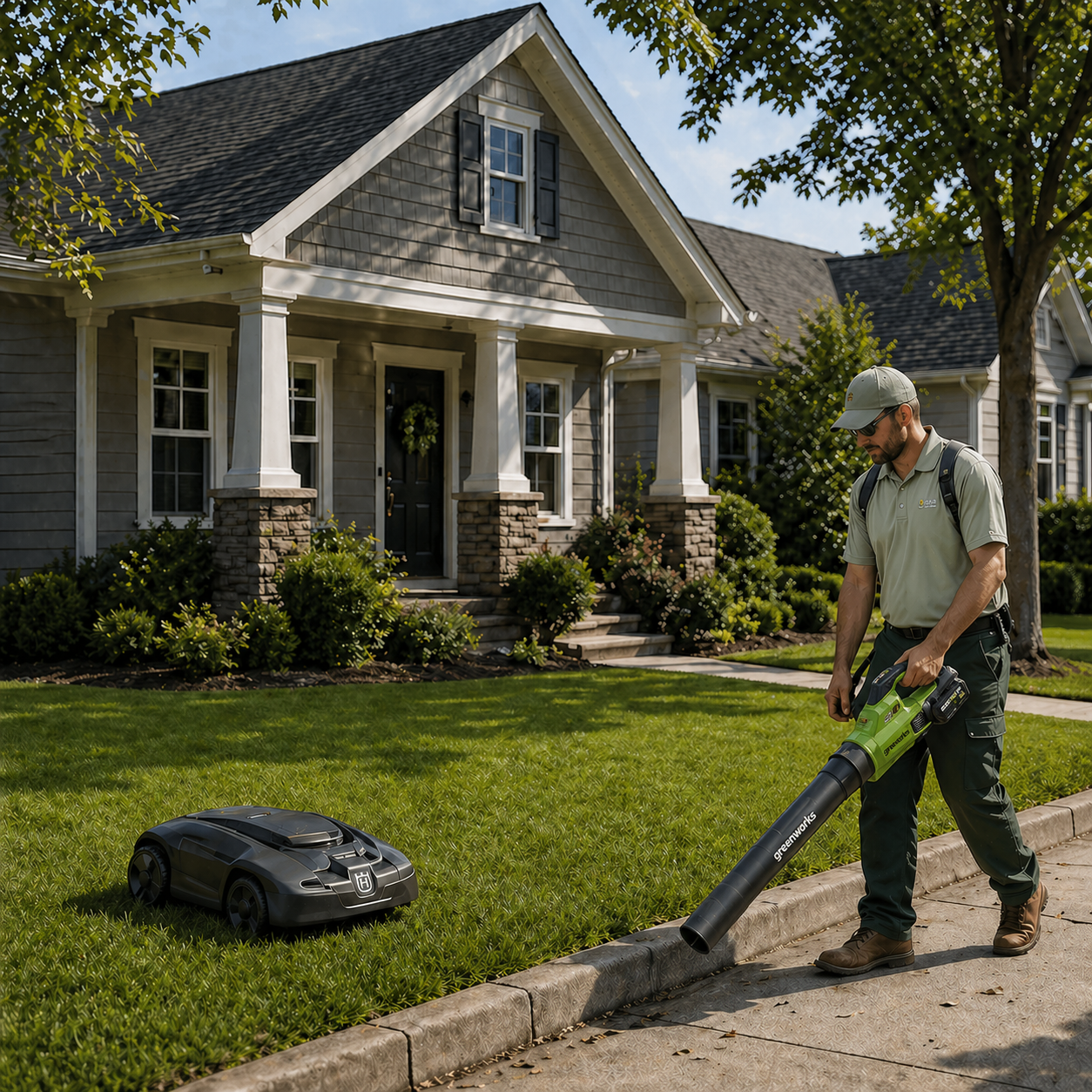
Robotic mowers could run in parallel while the operator handled edging, blowing, quality control, and customer-facing tasks.
The business moved from sequential labor to parallel execution.
That was the moment Eco-Mowing became something different.
It was no longer just lawn care. It was a neighborhood maintenance system.
The Pilot Block Became the Proof Point
The pilot block became the first real test.
With 15 homes on the same street, 3–4 robotic mowers, and one operator managing the workflow, the service could be completed in approximately 6–8 hours.
At $35 per home, the block produced around $525 per visit — without the inefficiency of driving from house to house.
The transformation was not based on working harder.
It came from redesigning how the work was organized.
Calibration: Making the System Stronger After the First Test
Once the model proved itself, the system could be refined.
The block could increase from 15 homes to 20. The robotic fleet could expand from 3–4 units to 6–10. The workflow could be standardized. The operator’s role could become more focused, less chaotic, and more productive.
This is where the system started to mature.
Eco-Mowing was no longer depending only on the operator’s effort.
It was building an operating model around density, repetition, and parallel execution.
The Community Layer Changed the Conversation
Then another layer emerged: community alignment.
Instead of positioning Eco-Mowing as just a cheaper or more efficient lawn service, the model introduced a cause-based layer.
A portion of recurring neighborhood revenue could be directed toward a local school.
That changed the conversation.
Homeowners were no longer simply buying lawn care.
They were participating in a neighborhood system that improved their own homes while supporting something local and visible.
The economics became stronger because the emotional logic became stronger.
The Result: A Neighborhood Utility Model Emerged
At 20 homes per block, the model could generate approximately $700 per visit and around $2,800 per month per block.
Of that, roughly $800 per month could be donated to a local school, creating a clear community benefit while preserving a more efficient operating model.
This is where Eco-Mowing began to evolve from a service business into a utility-like system.
The final opportunity was no longer individual homeowners paying separately.
It was the possibility of HOA-level contracts: 200 homes, predictable revenue, no constant acquisition cost, no scheduling chaos, and a repeatable neighborhood operating model.
The Bigger Insight: Low-Margin Industries Are Often Structurally Inefficient
That is the power of system design.
Eco-Mowing did not create value by inventing lawn care.
Lawn care already existed.
It created value by organizing a fragmented market in a better way.
The flywheel became clear:
Density creates efficiency.
Efficiency enables parallel execution.
Parallel execution increases output.
Higher output improves margin.
Margin funds community benefit.
Community benefit supports institutional adoption.
That is the real transformation.
A scattered operator becomes part of a structured system.
A group of disconnected lawns becomes a block-based service route.
A simple service becomes a neighborhood maintenance utility.
And a low-margin industry suddenly reveals that the margin was not missing — it was trapped inside inefficiency.
What Eco-Mowing Proves
Eco-Mowing proves something important for any fragmented operator industry:
The growth path is not always more marketing, more labor, or more customers.
Sometimes the growth path is redesigning the work itself.
The same pattern can apply to lawn care, cleaning services, pool maintenance, pressure washing, mobile detailing, home repair, and many other service categories where independent operators are working hard inside broken structures.
The opportunity is not just to grow these businesses.
The opportunity is to install the correct growth path.
That is what Eco-Mowing demonstrates.
Growth is not achieved by doing more scattered work.
Growth happens when the work is reorganized into a system that can carry more value, with less friction, and with a stronger reason for people to participate.