
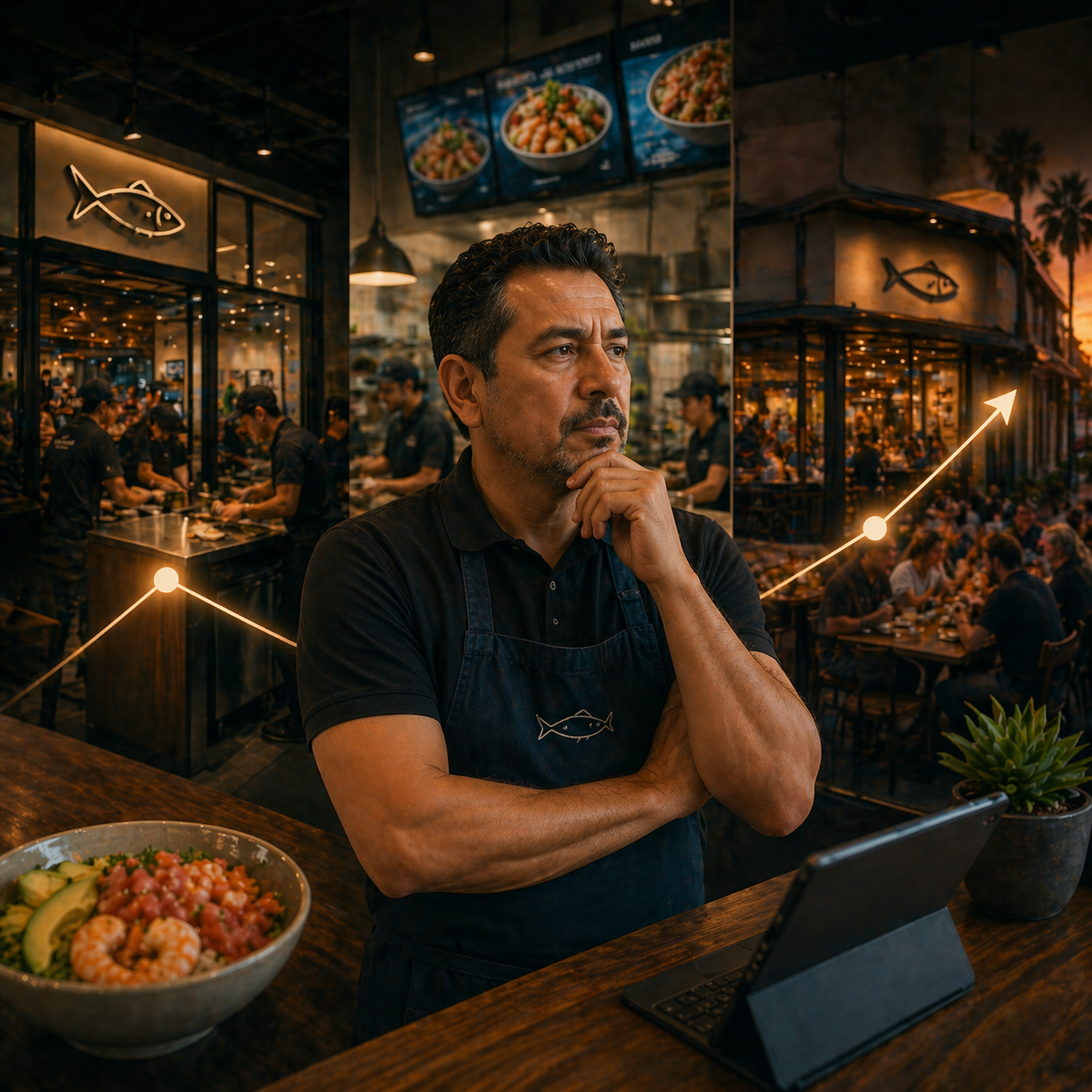
Carlos thought he was growing.
His first fast-casual location had worked.
Simple menu. Strong demand. Clean operation.
So he opened a second.
Then a third.
Orders increased.
Staff doubled.
Days got fuller.
From the outside, it looked like expansion.
Inside, it started to feel heavier.
Baseline Perception
Carlos believed the signal was clear:
"We're busier than ever. That means we're progressing."
Each new location added volume.
Each week added more tickets.
The system was moving.
And movement felt like growth.
Escalation
So he leaned in.
More hires to keep up with demand.
More inventory to avoid stockouts.
More oversight to maintain standards.
He started splitting his time between locations
Mornings in one kitchen.
Afternoons solving issues in another.
Evenings reviewing numbers that felt harder to interpret.
The business wasn't slowing down.
But it wasn't getting easier eithe
Friction Signals
The pattern didn't break all at once.
It showed up in small, repeatable ways.
One location executed perfectly.
Another struggled with the same menu.
Customers loved the food-when it was consistent.
But consistency depended on who was working.
CARLOS, 50 - FAST CASUAL SEAFOOD OWNER
New staff came in quickly.
But training felt different every time.
Managers started asking more questions.
Not fewer.
Carlos noticed something else.
When he wasn't present, things shifted.
Decisions slowed.
Standards drifted.
Problems waited.
Demand kept growing.
But so did the pressure behind it.
"The difference isn't how much high-performing teams
do-it's how little time they spend doing the wrong
things."
The False Conclusion
At first, he diagnosed it the way most founders do.
"We just need to tighten execution."
So he added:
More checklists.
More supervision.
More involvement.
Because if activity was high.
The Turn
But the pattern didn't stabilize.
More effort didn't create more control.
It created more dependency.
And that's when something subtle became visible.
The issue wasn't how hard the team was working.
It was what the system was actually built on.
The Truth
The business wasn't progressing.
It was expanding activity without confirming readiness.
Activity had increased:
more orders
• more staff
• more locations
But progress requires something different.
It requires that what works in one location
can be repeated in another-without variation.
Carlos didn't have that.
He had demand.
He had effort.
But he didn't have a system that behaved the same way twice.
So each new location didn't multiply success.
It multiplied inconsistency.
System Framing
Activity grows faster than structural readiness.
Demand validates the concept.
But the operation has not been stabilized into a replicable system
So instead of:
growth -» consistency -> scale
The sequence becomes:
demand -›expansion -› fragmentation
And the difference between those two paths is not effort.
It's clarity.
Implication
If this continues, the outcome is predictable.
More locations will not create more control.
They will create:
• more variability
• more founder dependency
• more operational pressure
• less reliability across the system
From the outside, the business will still look like it's growing.
Internally, it will become harder to sustain.
Transition to Clarity
At some point, the question shifts.
Not:
"How do we do more?"
But:
"What exactly is working-and can it be repeated without us?"
Because scaling is not about increasing activity.
It's about confirming readiness.
And most businesses don't realize the difference..
until activity has already outpaced it.